

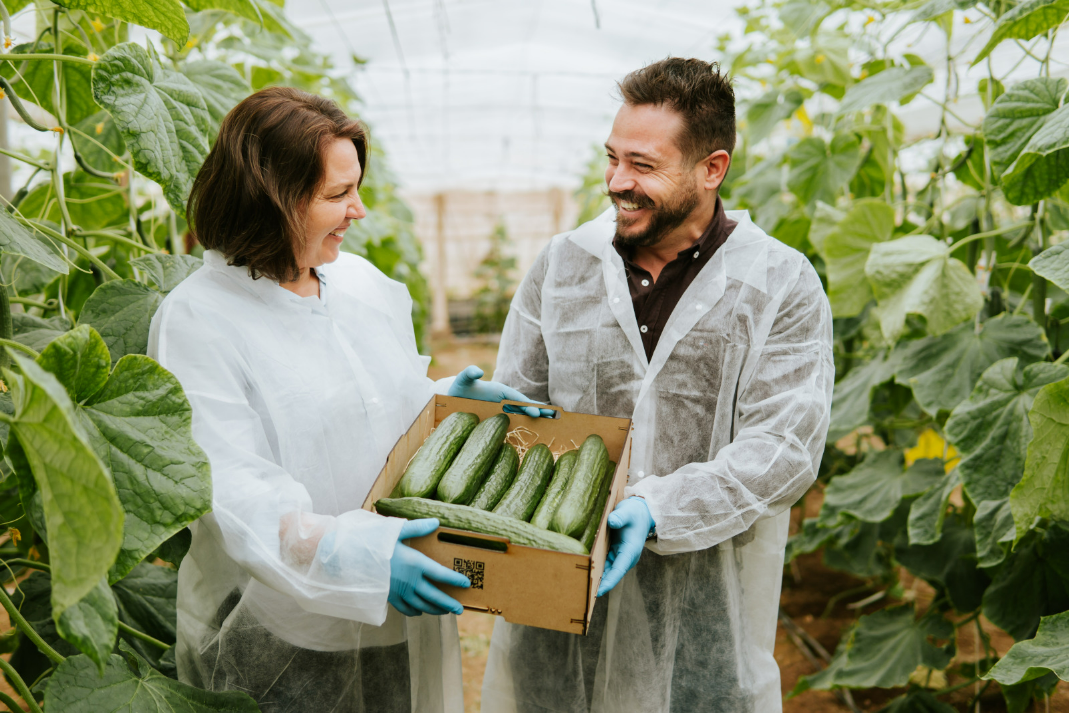
The production of greenhouse cucumbers has expanded rapidly over the last years. Greenhouse cucumbers can be one of the most productive crops. However, this productivity relies on precise control of irrigation, plant nutrition, and the growing environment, in addition to the effective management of pests and diseases. Greenhouse cultivation of cucumbers has many advantages over regular, open-field cultivation. In this article, we will discuss some of these advantages and the need to prioritize cucumber production under greenhouse cultivation.
Enhanced Production
Cucumber is an indeterminate vining, frost sensitive semi-tropical annual plant. Consequently, it responds and grows best when conditions of high temperature, humidity and light intensity are combined with a constant and plentiful supply of water and nutrients. Cucumbers produce numerous fruits under optimal growing conditions. In order to be cost-effective and sustainable, it is crucial for growers to take the right decisions about cultural management, nutrient management, pest & disease management, labor balance and marketing.
The cucumber crop needs to be examined frequently, and its growth should be directed and precise. Your challenge as a grower is to keep the cucumber plant balanced and attain the best fruit production.
Managing the cucumber plant
The grower’s crop management objectives change over the different phases of the cucumber crop’s growth. After transplanting, the grower’s goal is to have a good establishment and a healthy, vegetative cucumber plant. The focus should be on establishing a strong healthy root system to support the plant fruit production afterward, in parallel to a strong balanced plant. Effective plant management, resulting in optimal production, requires control of the growing climate conditions, soil, plant density, watering, and pests & disease control.
Ideal Greenhouse Environment
Climate Conditions:
Cucumbers demand very stable climate conditions. The ideal temperatures for growing are around 20-25ºC during the day and 15ºC during the night; humidity should be around 60-70% during the day and higher at night. While maintaining precise temperatures is necessary in order to optimize the production of cucumbers, there is a relationship between temperature and light, even though cucumbers can grow with less than 12 hours of light.
Soil:
It is important to have a good media/soil depth, of at least 50 cm; the recommended pH range for good plant development is 5,5-6,8.
Plant Density:
The number of plants per ha depends on the season, varieties, etc. The plant density range in different seasons should be:
| SEASON | OPTIMUM PLANT DENSITY (pl/m2) |
| From summer to winter | 1 – 1,1 |
| From fall to winter | 1 |
| From spring to summer | 1-1,3 |
Humidity:
Careful management of humidity in the greenhouse is an important part of maintaining both crop production and crop health. Humidity can influence everything from plant growth rates to disease problems. Cucumbers perform well under conditions of high relative humidity. The target should be 60-70%.
Watering:
In low humidity conditions, water supply is critical. Cucumbers grown at lower relative humidity conditions require a lot of water, and water shortage causes misshapen fruits, abortion, or less vigor to sprout secondary shoots. It is very important to ensure the availability of water, especially after the beginning of harvesting.
Pests and Diseases:
Greenhouse humidity also impacts on the presence of pests and diseases. If leaf surfaces become wet, from drops, condensation, or misting, the risk of infection increases. Good cucumber disease management should include crop hygiene practices, rapid positive diagnosis of any unfamiliar or unusual plant symptoms, and routine monitoring & treatment.
Become a pro with Hazera’s cucumbers
Hazera’s portfolio of cucumbers consists of a range of varieties belonging to diverse segments, with the new Hazera PRO+ series composed of new varieties with special traits and an extra protection package of resistances. PassioND is the first variety developed for the Spanish market, offering key features such as:
- Fruit length stability and uniformity over the entire season
- An open plant with medium sized leaves to allow air circulation
- Nice quality of straight ribbed fruits
- Extra disease protection with a package of 4 resistances: CYSDV, CVYV, Powdery mildew and as new tolerance to New-Delhi virus (ToLCNDV).